I’m soft launching my résumé today!
I’m not looking for work right now, but I had been gifted some time with a career coach, so it seemed like a good time to update everything. We spent quite some time going through who I was, who I am, and who I want to be professionally. We polished the résumé and tidied the LinkedIn profile.
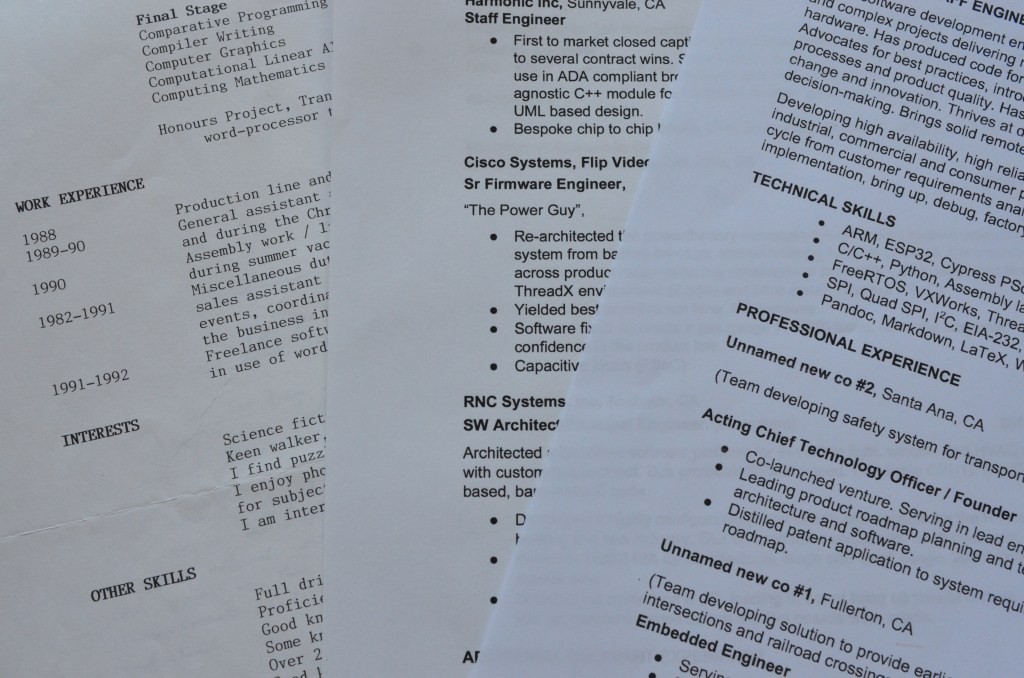
The 15 year limit
There are things I’ve done in the past that I am extremely proud of. I did things well, and I learned many new skills along the way. Some of the things I did well I ended up doing for a long time. You can imagine why I wanted to dissuade recruiters from pigeonholing me in a role. There are guidelines about work experience being more than 10-15 years old being too old for your résumé, so thankfully, those positions have now aged out.
However, those skills show how rounded my abilities are. I’ve tackled all manner of fun things: GUI software, ASIC design verification(DV), Boot ROM code for an SoC, and lots of firmware for embedded systems. I’ve worked on industrial-grade equipment for highway infrastructure and offshore oil exploration. I’ve coded for commercial-grade systems for broadcast TV. I’ve developed consumer products in the form of video cameras, BBQ grills, STEAM robots. I’ve worked in three-man start-ups and major corporations in the UK and US.
Letting go of rusty skills
Taking those years out of my résumé hides a lot of information. Is that information really relevant? Without those positions, no one will know that I’ve been involved with FPGA, ASIC, and PLD development. Even my Cypress PSoC experience has aged out. Sure, I wouldn’t trust myself to write good Verilog today, but it’s a short re-training. What do I remember about batteries, apart from the overall discharge curve and basic charging rules? Having an awareness that there are upper and lower temperature limits, how various “gas gauges” work, and a vague awareness of low voltage/deep discharge protection.
There are languages I’ve used in academia and in industry, but do I really know any beyond C at this point?
- Academic:
- Pascal
- LISP
- Prolog
- BCPL
- Early years:
- Arm Assembler (ARM2)
- Motorola Assembler (CPU08, 68K, HC16)
- C
- Visual Basic, BBC Basic V, Sinclair/ZX Basic
- Perl, TCL, SED, AWK
- Verilog
- Recent times:
- C, C++
- Python
- Rust
There are other languages I’ve picked up and put down. I got involved in part of the DevOps for automated build at the last company and learned the basics of several new-to-me languages. I bounced in and out, patching up scripts to do what I needed against the clock, and now 12 months later, I don’t even remember the names of the languages.
The custom résumé
A lot of the big picture stuff sticks with you, and some of the minutia. You have the fundamental understanding and can warm start when returning to a past skillset. Admitting I had these skills on my résumé might be the difference between a phone screen or a rejection letter. There seems to be an option of tweaking my résumé for each company I apply to.
Here I will show my age. I had the good fortune to live in a household where we had an electronic typewriter. It could store ten documents. My mum graciously allowed me to save my curriculum vitae (CV) in the last slot. The first five slots were form letters for my dad’s catering business. I would print 10 copies at a time and handwrite cover letters. Of course, fresh out of college, that makes sense. Some of my classmates had a home PC, while others went to a local typist to get their CV typed up and then took the master copy to the library to photocopy. Can you imagine doing a custom résumé with those logistical constraints?
I am seriously considering moving my résumé from an MS Word .docx to a GitHub repo full of Markdown files and use a language like R to build it each time based on keywords and key experience. I have also built a ChatGPT which I trained with my LinkedIn profile, last 4 iterations of my résumé, and a few other paragraphs so that I can use that to help draft application letters, and maybe custom résumés, CVs, “About the author” introductions and the like. My own PR rep if you like. Of course, the practicalities are that every career and résumé coach I’ve worked with used MS Word, so that is a format I must maintain.
Learning to be egotisitical
Every time I add a new position to my résumé or LinkedIn profile, I find myself wanting to say how great the product we built was rather than how essential I was to the effort. I said before I’m proud of many things I’ve done in my career; that does not translate to being vocal about it.
LinkedIn was tough to update this time around. I had a lot of projects detailed and work experience visible. Every entry had been written at a different time, in a different mood. My coach was hesitant to make me “undo all that good work”. Yes, each piece was written with care and love, but there was no consistent style. That had to be fixed.
I wanted to make my LinkedIn Profile 7.0 (I’ve been through that many iterations since I first joined). LinkedIn doesn’t work that way. Each position and each project went live after every edit. A smattering of “dot releases” would have been good when I was sure the updated entry was good, but no, basically every commit went live in real-time. Thankfully, I had notifications turned off, so my followers didn’t get spammed.
LinkedIn shows only the first two lines of each project and position when looking at a profile overview. I had to make sure there was a good hook about my excellence visible. I think I managed to pull it off; recruiter outreach did not slow down, even though I’m not “open to” anything at the moment.
Do you have a company email address?
I’ve added a new email address to the résumé and LinkedIn profiles.
I was consulting as a tech advisor to a field service company when I found myself needing to reach out to a parts vendor for some information. I did not have an email address at the company I was advising, so I used my Gmail address. The vendor was not happy responding to a personal account and wanted a company name. I decided it was time to get an email address to isolate consulting from everything else, and not run afoul of vendor policy again.
I then thought it would also be a good address for job applications too. The address is simple, but long.
alex@alex-odonnell-embedded.tech
Now I’ve got a domain
To get an email address like that, I ended up with a domain name. Seems a shame to have a whole domain just for an email address.
I know a few people who have their resumes hosted online, it seems like a good idea. I now have a page where I can share my portfolio. I’ve kept it simple for now. I state who I am and provide the PDF of my résumé. It’s almost ready for the launch.
There are still a few issues
I just grabbed a simple WordPress Portfolio template that seemed to suit, though I believe they are more aimed at photographers and artists. I’ve played with Fiverr and have seen logos that I like but don’t love, so I made one of my own, which I like but don’t love. I made a model PCB (printed circuit board) out of Lego. I can do better, but it will involve a more detailed SNOT (Studs Not On Top) model to get better proportions of traces visible under the solder mask and maybe a color palette change, too. I have an image on the landing page showing a PCB with a blue solder mask; the logo is green.

My profile photos are old, I mean a decade old, so I am showing first signs of grey. A different story would be told by new headshots. My photographer has retired, but we are working out details for a new shoot.
So this is the soft launch?
For a soft launch, this is pretty vocal. It’s all live right now, though I reserve the right to take it down while polishing things up. I know some of you will be curious, and you are welcome to explore alex-odonnell-embedded.tech, and follow the link from there to my professional profiles (though the WordPress link will bring you back to this blog).
Once I get the logo nailed and the new headshots, I’ll make a big whoop about it on LinkedIn and a few other places. That will be the official launch.
On brand
The résumé, CV, LinkedIn, and profile page all should tell the same story, but they can say it at different levels of detail. LinkedIn, I’ve been told, should tease people into wanting to see the résumé. I can use the profile page to detail what consulting and contract gigs I would be interested in, as well as showcase the skills I can deliver.
There should be consistency in style. It’s a brand. I’m not selling a million automobiles; I’m selling a talented individual, but still, branding matters. That might be a hard one to sell; as a consultant, I often jump into a portion of the problem and solve it as an IC (individual contributor), whereas I like tech lead roles in my full-time employment. I hope that starts becoming evident over time.
One thing I really must convey is my ability to communicate effectively. Consultants need to be able to grasp the situation swiftly and accurately and deliver a clean, well-documented solution so others can maintain or complete the code. Tech leads need to work well with stakeholders to gather requirements and manage expectations while also providing a game plan to their team and guiding them to the answer.
Am I overthinking this?
I’d be curious to know what you’re thoughts on personal/professional branding are. We must both build and maintain our reputation among those we work with but also have a formal document to expose our abilities to those who don’t know us yet. Are you just listing the jobs you did on LinkedIn, or are you trying to present a complete account? Do you want to be discoverable through employment sites, with distracting recruiter outreach, or would you rather quietly wait until you are ready to go job shopping?
I like the random recruiter or hiring manager interactions. I’ve gotten some good jobs that way. I also want to perform a focused job search, targeting companies or industries that I am interested in. To avoid too many recruiters, I do need an accurate profile that highlights where I’m going more than where I’ve been. I think I’m there now.
For those of you on the job market, I wish you well in your search. I was blessed with a good coach and program as part of my last severance package. I hope if you get unlucky in a layoff, you get lucky with a benefit like this.
As ever, your feedback, comments, or questions are welcome.
 Glorified Plumbing
Great résumé!
Some suggestions:
• Reduce the verbiage of the ‘intro’ section (119 words seemed a bit longish.) I’m not sure which/what part(s) to trim though.
• Office365 Word Editor suggested the following grammar+usage edits:
LikeLiked by 1 person
It’s interesting to see how not only do Grammarly and Word have different opinions on grammar, but your MS Word 365 differs from my MS Word for Mac.
I was surprised I was guided to such a long intro, as my older résumés would rely on the cover letter to handle that sort of information.
Maybe it’s just my UK English, but:
“Team-process” is the process used to wrangle the team.
“Team processes” are the processes used by the team.
MS Word was insisting I should say “time lost to lose wires” instead of “time lost to loose wires”. What I was trying to convey was that a wire has come loose, making an intermittent connection or an open one. This is quite different from the duration required to misplace a wire.
Do I solve problems, or am I an analytical person? If I am analyzing this comment, I am an Analytical Person trying to solve the problem of looser grammar in a resume.
I don’t think I’ve ever had a résumé where I’ve got it perfect. There’s always something I left on that trips me up in an interview (I forgot what SIMD meant, even though I spent months verifying the Verilog for a SIMD unit. Single Instruction, Multiple Data. We were doing vectors back in 2001.) There are times when something ages out, and you want to brag that you have those skills. There was even a time when I updated my email address wrongly, but the recruiter hunted me down, and we talked despite that mistake.
The more eyes, the better. Updates will be made.
Thanks.
LikeLike
Great work!
I love the LEGO as a logo. PCBA. Keep trying. I’ve used generative AI to create different banners for LinkedIn, Twitch, Discord, and other sites.
This is Duppy BTW. I tried to log in but am getting “could not create noonce” errors.
LikeLiked by 1 person
I must have notifications disabled; I didn’t see this comment until now.
Thanks. I know some SNOT techniques that would improve the Lego logo, but I’m glad the current version is appreciated.
I’d like to get a custom logo sometime. I’ve considered reaching out to some talented artists I know, but I also know I’ll have to pay for their help, and I don’t have that in the budget yet. Until then, homegrown or AI-generated art will suffice.
I don’t think I’ve done anything funky with permissions. I did see [this question](https://wordpress.org/support/topic/failed-to-create-a-login-nonce-2/) on a WordPress forum. I wonder if it’s the same for you.
LikeLike